The gut microbiome plays a critical role in shaping host immunity and metabolic signaling, both of which are central to cancer development and treatment response.
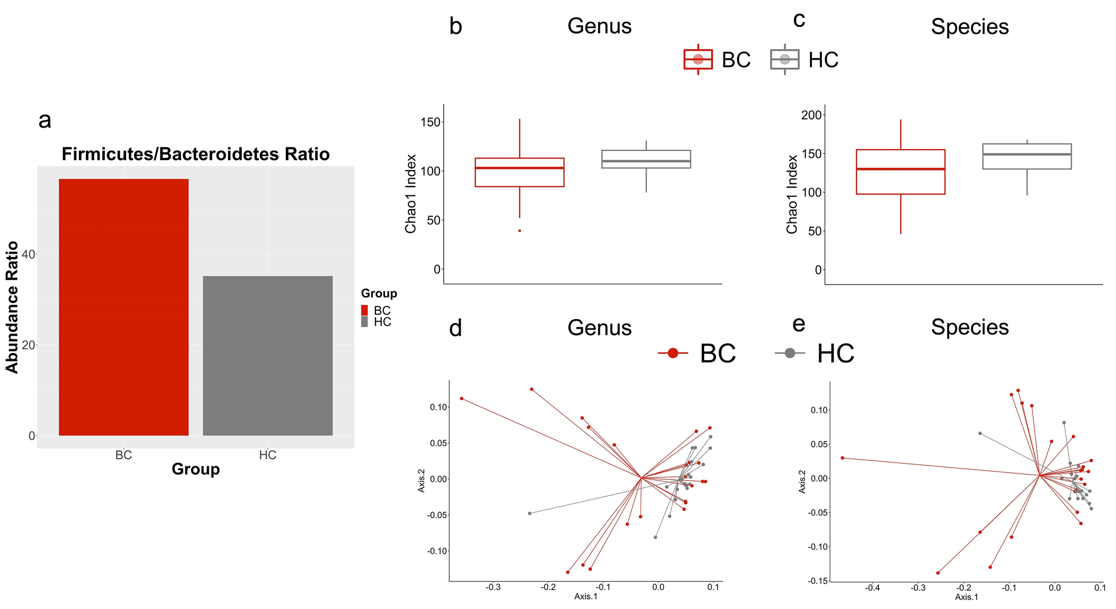
Our work in breast cancer (BC) and colorectal cancer (CRC) demonstrates that cancer patients exhibit distinct gut microbiome signatures, including loss of short-chain fatty acid (SCFA)–producing symbionts and enrichment of microbes linked to inflammatory and tumor-supportive pathways. In BC, we identified a significant depletion of Faecalibacterium prausnitzii and related SCFA-producing taxa, accompanied by reduced propionate biosynthesis, supporting the concept that microbiome-driven loss of anti-inflammatory metabolites contributes to tumor-promoting immune tone. In CRC, we are mapping microbial features associated with tumor location and age of onset, and identifying candidate microbial drivers of epithelial proliferation, WNT/MAPK signaling, and immune remodeling.
Key Findings & Interpretation
- Breast cancer patients show loss of SCFA-producing bacteria and associated metabolic pathways, suggesting a role for the microbiome in pro-inflammatory tumor microenvironments.
- In colorectal cancer, specific microbes (e.g., Negativicoccus, Fusobacterium) correlate with tumor location, age of onset, and epithelial signaling pathways, pointing to microbiome-influenced tumor biology.
- Microbiome composition also correlates with response to immune checkpoint therapy and risk of immune-related adverse events, indicating that the microbiome may shape therapeutic sensitivity and toxicity.
- Together, these studies support a model in which the microbiome contributes to cancer susceptibility, tumor progression, and treatment outcomes by modulating immune and metabolic pathways.
Future Directions
- Identify microbial metabolites and structural components that influence epithelial transformation and tumor-associated immune responses.
- Perform causal testing using gnotobiotic mouse models and ex vivo organoid-immune co-culture systems to validate pro-tumorigenic vs. tumor-protective microbial pathways.
- Develop microbiome-based biomarkers to improve cancer risk stratification, early detection, and prediction of immunotherapy response.
- Explore precision microbiome interventions (diet-based, probiotic consortia, microbial metabolites) to enhance anti-tumor immunity and reduce treatment toxicity.
Selected Publications
Cherwin CH, Hoang J, Roberts EK, Mangalam A. Gut Microbiome and Symptom Burden in Obese and Non-Obese Women Receiving Chemotherapy for Breast Cancer. Biol Res Nurs. 2025 Jul;27(3):411-422. PMID: 39928757.
Shrode RL, Knobbe JE, Cady N, Yadav M, Hoang J, Cherwin C, Curry M, Garje R, Vikas P, Sugg S, Phadke S, Filardo E, Mangalam AK. Breast cancer patients from the Midwest region of the United States have reduced levels of short-chain fatty acid-producing gut bacteria. Sci Rep. 2023 Jan 11;13(1):526. PMID: 36631533.

Chau J, Yadav M, Liu B, Furqan M, Dai Q, Shahi S, Gupta A, Mercer KN, Eastman E, Hejleh TA, Chan C, Weiner GJ, Cherwin C, Lee STM, Zhong C, Mangalam A, Zhang J. Prospective correlation between the patient microbiome with response to and development of immune-mediated adverse effects to immunotherapy in lung cancer. BMC Cancer. 2021 Jul 13;21(1):808. PMID: 34256732.
Shrader HR, Miller AM, Tomanek-Chalkley A, McCarthy A, Coleman KL, Ear PH, Mangalam AK, Salem AK, Chan CHF. Effect of bacterial contamination in bile on pancreatic cancer cell survival. Surgery. 2021 Mar;169(3):617-622. PMID: 33268071
Li H, Meza LA, Shahi SK, Zhang Z, Wen W, Hu D, Lin H, Mangalam AK, Luo J. Effects of alcohol on gut microbiome in adolescent and adult MMTV-Wnt1 mice. Front Oncol. 2025 Jul 16;15:1557040. doi: 10.3389/fonc.2025.1557040. PMID: 40740867