The oral cavity is the second most diverse microbial environment in the body and a key interface where microbes, diet, immune cells, and environmental exposures meet.
Our recent work shows that people with MS exhibit distinct oral microbiome and salivary metabolite profiles, including decreased levels of the neuroprotective metabolite hypotaurine and a shift toward pro-inflammatory bacterial communities. Because saliva and oral swabs are easy to collect, the oral microbiome offers a non-invasive window into systemic immune health, and may provide early indicators of neuroinflammatory activity.
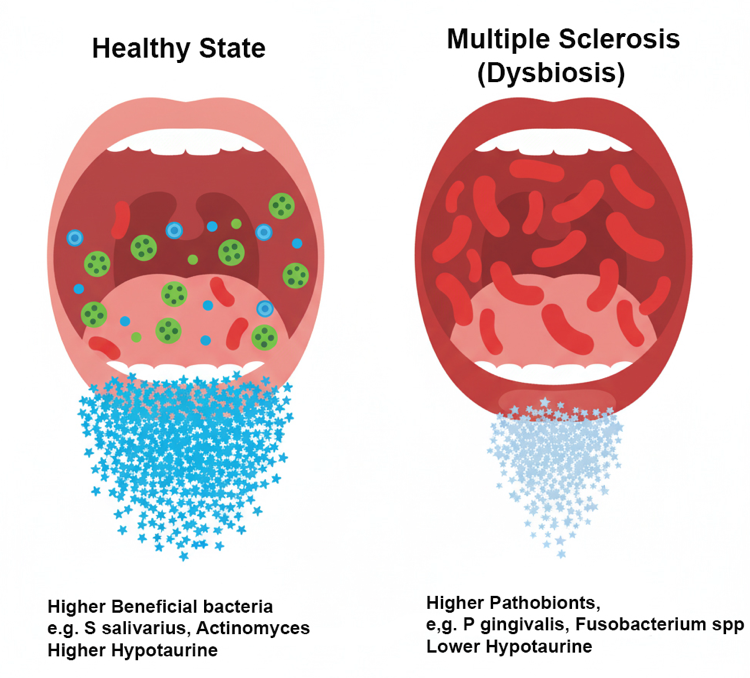
Key Findings & Interpretation
- PwMS show altered oral microbiome composition, including changes in early-colonizing symbionts and increased pro-inflammatory taxa.
- The salivary metabolome is altered in MS, including reduced hypotaurine, a precursor of taurine with antioxidant and myelin-supporting functions.
- Shared features of dysbiosis across oral and gut microbial communities suggest a broader mucosal immune imbalance in MS.
- These findings support a mouth-gut-brain microbiome–immune network, rather than isolated microbial changes at a single site.
Future Directions
- Longitudinal studies to correlate oral microbiome and metabolite profiles with disease activity, relapse, and treatment response in MS.
- Use preclinical models to test whether MS-enriched oral bacteria (pathobionts) promote neuroinflammation, and whether MS-depleted bacteria (symbionts) can restore immune balance.
- Employ organoid systems, epithelial co-culture models, and human immune cell assays to define how oral bacteria and their metabolites influence mucosal signaling and T-cell differentiation.
- Evaluate whether oral microbiome modulation (e.g., targeted probiotics, microbial restoration strategies) could serve as a non-invasive adjunct therapy for immune stabilization in MS.
Selected Publications
Ganesan SM, Yadav M, Ghimire S, Lehman PC, Patel AJ, Woods S, Olalde H, Hoang J, Paullus M, Cherwin C, Gill C, Cho T, Mangalam AK. Relapsing-Remitting Multiple Sclerosis Is Associated With a Dysbiotic Oral Microbiome. Ann Clin Transl Neurol. 2025 Oct 6. doi: 10.1002/acn3.70212. PMID: 41051180

Fitzjerrells RL, Meza LA, Yadav M, Olalde H, Hoang J, Paullus M, Cherwin C, Cho TA, Brown G, Ganesan SM, Mangalam AK. Multiple sclerosis patients exhibit oral dysbiosis with decreased early colonizers and lower hypotaurine level. NPJ Biofilms Microbiomes. 2025 Oct 20;11(1):199. doi: 10.1038/s41522-025-00787-7. PMID: 41051180. This article is in the top 5% of all research output tracked (29,592,456) by Altmetric.
Salman U, Dabdoub SM, Reyes A, Sidahmed A, Weber-Gasperoni K, Brown R, Evans IA, Taylor E, Mangalam AK, Kanner L, Curtis V, Ganesan SM. Dysbiotic Microbiome-Metabolome Axis in Childhood Obesity and Metabolic Syndrome. J Dent Res. 2025 May 31:220345251336129. doi: 10.1177/00220345251336129. PMID: 40448590
Zhang J, Sun L, Withanage MHH, Ganesan SM, Williamson MA, Marchesan JT, Jiao Y, Teles FR, Yu N, Liu Y, Wu D, Moss KL, Mangalam, AK, Zeng E, Lei YL, Zhang S. TRAF3IP2-IL-17 Axis Strengthens the Gingival Defense against Pathogens. J Dent Res. 2023 Jan;102(1):103-115. doi: 10.1177/00220345221123256 PMID: 36281065