People with MS show gut dysbiosis that includes the loss of bacteria capable of metabolizing dietary phytoestrogens into anti-inflammatory compounds such as S-equol.
Using the EAE model, we demonstrated that an isoflavone-rich (phytoestrogen-containing) diet protects against neuroinflammation only when these bacteria are present, whereas a phytoestrogen-free diet leads to disease exacerbation and microbial and immune profiles resembling those observed in MS. These findings indicate that diet and microbiota act together to regulate mucosal and CNS immune tone.
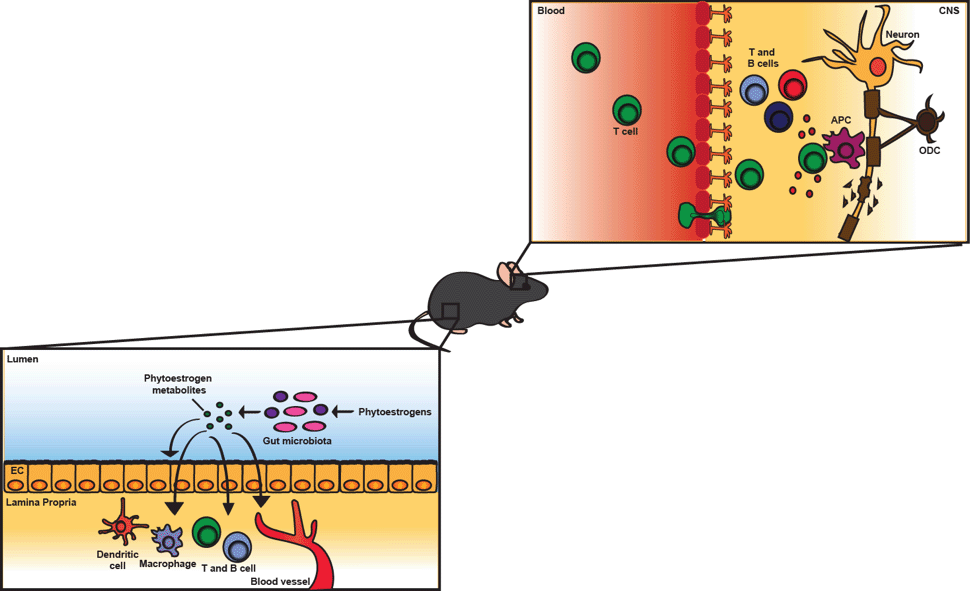
Key Findings & Interpretation
- MS is associated with the loss of phytoestrogen-metabolizing bacteria, including Parabacteroides and Adlercreutzia, impairing production of anti-inflammatory metabolites.
- Isoflavone-rich diets restore these microbes and shift the microbiome toward a regulatory, health-associated state.
- Phytoestrogen-free diets increase Akkermansia muciniphila, enhance inflammatory LPS biosynthesis pathways, and worsen IL-17A-driven neuroinflammation.
- Together, these findings demonstrate that microbiome-supported phytoestrogen metabolism is a powerful modulator of neuroimmune balance.
- Use genetically modified and gnotobiotic mouse models to define microbial metabolite → immune signaling mechanisms in MS.
- Develop synbiotic therapies (diet + targeted beneficial bacteria) to restore phytoestrogen metabolism and promote immune tolerance.
- Advance precision nutrition approaches that personalize dietary recommendations based on microbial functional capacity.
Future Directions
We are now pursuing:
- Use genetically modified and gnotobiotic mouse models to define microbial metabolite → immune signaling mechanisms in MS.
- Develop synbiotic therapies (diet + targeted beneficial bacteria) to restore phytoestrogen metabolism and promote immune tolerance.
- Advance precision nutrition approaches that personalize dietary recommendations based on microbial functional capacity.
Selected Publications

Jensen SN, Cady NM, Shahi S K, Peterson SR, Gupta A, Gibson-Corley KN, Mangalam AK (2021). Isoflavone diet ameliorates experimental autoimmune encephalomyelitis through modulation of gut bacteria depleted in patients with multiple sclerosis. Sci. Adv. 7, eabd4595. doi: 10.1126/sciadv.abd4595. PMID: 34244137

Ghimire S, Cady N, Lehman P, Peterson S, Shahi SK, Rashid F, Giri S., and Mangalam AK (2022). Dietary Isoflavones Alter Gut Microbiota and Lipopolysaccharide Biosynthesis to Reduce Inflammation. Gut Microbes. Jan-Dec;14(1):2127446. doi: 10.1080/19490976.2022.2127446. PMID: 36179318
Shrode RL, Cady N, Jensen SN, Borcherding N, Mangalam AK (2022). Isoflavone consumption reduces inflammation through modulation of phenylalanine and lipid metabolism. Metabolomics. Oct 26;18(11):84. doi: 10.1007/s11306-022-01944-1. PMID: 36289122.
Faraz R, Ghimire S, Mangalam, AK, Giri S (2023). A UPLC-MS/MS Based Rapid, Sensitive, and Non-Enzymatic Methodology for Quantitation of Dietary Isoflavones in Biological Fluids. Molecules. 2023 Sep 21;28(18):6729. doi: 10.3390/molecules28186729. PMID: 37764503

Cady N, Peterson SR, Freedman SN and Mangalam AK. Beyond Metabolism: The Complex Interplay Between Dietary Phytoestrogens, Gut Bacteria, and Cells of Nervous and Immune Systems. Front Neurol. 2020;11:150. doi: 10.3389/fneur.2020.00150. PMID: 32231636